
-
Moonchild (1978): Misty’s Take on Carrie
I’m probably not the target audience for a comic like Misty. The late‑70s supernatural comic was aimed at girls, but while hunting for some obscure Halloween reads for the site, I’m glad I picked this one up.
The tale: Rosemary has a moon‑shaped scar, just like her (off‑panel until the final act) grandmother. It’s the sign of telepathic powers. Rosemary’s mother is horrified by those powers.
The setup feels familiar. This is very much a take on Stephen King’s Carrie, published only a few years earlier. The story beats are all there — the school bullies who see Rosemary as a witch, the rising tension, and the big party climax at the end.
The writing from Pat Mills is good. The story is clear, episodic, and straightforward — and I don’t mean that negatively. It works. Whether it’s Norma’s gang taking out Rosemary’s best friend or her mother doing, well, Carrie’s mother things, it’s surprising how much they let through in 1970s comics. You do end up rooting for Rosemary, which is exactly what you want in a story like this.
One thing I really liked is how unmistakably of‑its‑era the story is. The language, the phrasing, the way characters speak — it’s all very late‑70s. And visually, the clothes and styling lock it firmly into that time. Unfortunately, this story (and many others) wasn’t colourised.
Compared with the more “in your face” horror of Scream — which we’ll get to later — Moonchild leans into slower supernatural tension. It’s welcome, and it suits the tone.
I’m not the target audience, but this was a pretty good adaptation of Carrie.
-
Dick Turpin An Antihero?
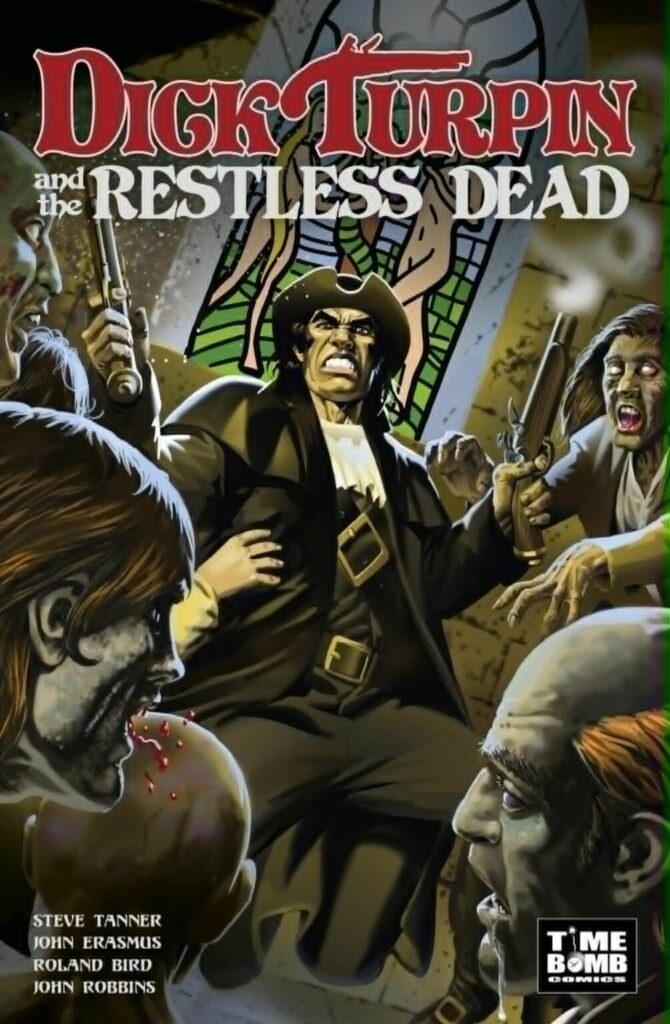
Written by Steve Tanner and illustrated by John Erasmus, Dick Turpin and the Restless Dead combines the historical figure with the horror/zombie genre. That sentence sounds ridiculous? Well, it is — and the story is. But it’s also a lot of fun.
There are other volumes of Dick Turpin in the Time Bomb catalogue, but thankfully you don’t need to have read any of them to enjoy this.
We follow Dick Turpin (who, in my head, sounded like a cross between Pirates character Jack Sparrow and WWE wrestler Razor Ramon — not sure what’s wrong with my brain) and gentleman thief Tom King. The latter seems to be there mostly to give Turpin someone to talk aloud to… which, let’s face it, is the reason for most comic‑book sidekicks.
The term most applicable here, I think, is antiheroes.
I won’t spoil too much of the plot. They come across a small hamlet with a zombie‑sized secret. It’s here that the artwork really stood out for me — the ghostly village in the centre of the forest is wonderfully atmospheric.
The horror and violence are present, but exaggerated for effect. This one’s a fun romp, an adventure‑type book. Comparable, I think, to those historical adventure episodes of British sci‑fi show Doctor Who.
-
Gerry Anderson’s Project Sword: what could have been
Gerry Anderson is best known for Captain Scarlet and Thunderbirds. Toys for Project SWORD were produced in 1967, along with a comic strip around the same time. Whether the idea was ever intended to lead into a TV series is largely speculation — but you can’t help wondering.
Time Bomb Comics have now published a modern graphic novel, written by Lizbeth Myles and illustrated by James Gray.
Spoilers on the book’s content belowSet in the year 3031, meteorites have devastated the Earth. SWORD (Space World Organisation for Research and Development) is tasked with the evacuation program, sending humanity to new worlds — in the case of this book, Mars.
The story mostly follows Alex Peake, who is called in when the computer responsible for selecting which humans to save — and which to leave behind for now — begins to malfunction. It’s a bleak premise. His search leads him to the computer’s programmer, Helen Bannock.
Helen is uncomfortable with her role in creating the selection system, but reluctantly agrees to help Alex. Together they discover that the computer hasn’t malfunctioned at all: it has learned to value all of humanity. Alex and Helen ultimately set the machine to self‑destruct.
There’s still the matter of how the meteorites came to be, and who — or what — caused them. Helen joins the team at the end of the book as SWORD vows to find a way to fix Earth for everyone.
What did I think?This felt like a pilot — a book that sets up more adventures for Project SWORD. The sequences with the rocket and vehicles genuinely made me smile. They have that unmistakable late‑60s TV flavour, with at least one eye on the toy market.
It’s an interesting project and a window into what could have been. Definitely worth a read, particularly if you have an interest in Gerry Anderson’s other franchises.
-
A Missing Batman Movie Between Burton’s Films? This Book is Close
Who remembers that movie in between Batman and Batman Returns that introduced Max Shreck and had Clayface as the villain. No? Well… now it kind of exists.
If you haven’t read Batman: Resurrection by John Jackson Miller, there are some minor spoilers ahead.
Batman: Resurrection is set between the two Burton films. Bruce and Vicki Vale (the love interest from the 1989 movie) are still sort of together, and Gotham is recovering from the Smilex gas attack in the first film. That attack is how this story’s Clayface comes into existence. He begins as a Smilex victim in a coma on a dodgy ward in Gotham Hospital — a dodgy ward with an even dodgier doctor, but going too far into that would drift into spoiler territory.
We also get a plot involving Clayface cosplaying the Joker, which anyone who played the Arkham games or watched the animated movie may find familiar.
What doesn’t work quite as well are lines like “Batman thought.” This is why I think superhero stories are best suited to visual mediums — comics or film — where internal monologue doesn’t feel quite so clunky.
So where does this sit? It has that “empathise with the baddie” streak of the Burton movies. In my mind, this book would have made a great straight‑to‑VHS film slotted between the two movies. The Clayface/Joker switch would have allowed a Jack Nicholson sound‑alike to step in, and some of the fight scenes feel like they’d work best in animated form.
It’s that kind of easy read. Not essential by any means, but fun.
-
Time Bomb Quantum: Death and Taxes
In 2024, the small indie comic label Time Bomb produced a bimonthly British sci‑fi anthology comic called Quantum.
Up until then, Smith’s was where I went for Batman reprints. But with the Batman Panini reprints cancelled (again), I gave Quantum a go. For a while, I loved heading into WH Smiths and finding the latest issue wasn’t out yet — going back later in the month… but you knew when it was in. Some of these stories were completely different to what I was used to reading.
I’m sure we’ll come back to a few stories from the anthology, but here’s one that stood out.
Death and Taxes, in issues 4 and 5. Written by Katie Cunningham with art from Tom Newell. The main premise: what if we achieved immortality, but the government owned your body after death — making the undead work forever.
It feels like a play on real life, where we all work for the majority of our lives in the hope of eventually receiving some peace in retirement. I also remember looking at our UK government at the time (though it applies to them all) and thinking… I wouldn’t put it past them.
The main character, Blodd, is written incredibly well in my opinion. She feels layered without being over‑explained. The tone of the story is dark and serious, particularly in contrast to some of the more out‑there sci‑fi stories in the book. Sadly, it only ran for two parts — but as a concept, it was terrifying.